
Where Sex Created the Cosmos
Egyptian Sacred Sexuality and the Architecture of Divine Union
In the beginning, there was only the Nun.
The dark waters. The primordial chaos. The nothing that contained everything, the potential that had not yet chosen a form.
And from that void, the first god emerged—Atum, the Complete One, the First Mound rising from the waters—and he was alone.
So he took his erect self in hand. His ejaculation became the beginnings of the world.
The Egyptians did not flinch from this erotic creation narrative. They carved it on temple walls. Spoke it in sacred hymns. Inscribed it in the Pyramid Texts, some of the oldest religious writings on Earth. The universe was born from divine self-pleasure. The first act of creation was erotic.
From Atum's seed came Shu and Tefnut—Air and Moisture, the first divine couple. From their union came Geb and Nut—Earth and Sky—lovers so intertwined, so perpetually locked in embrace, that they had to be forcibly separated so creation could unfold in the space between them. And from Geb and Nut, born of their forbidden union, came the four gods who would shape Egyptian spirituality forever: Osiris, Isis, Set, and Nephthys.
The entire Egyptian cosmos is a family born from desire.
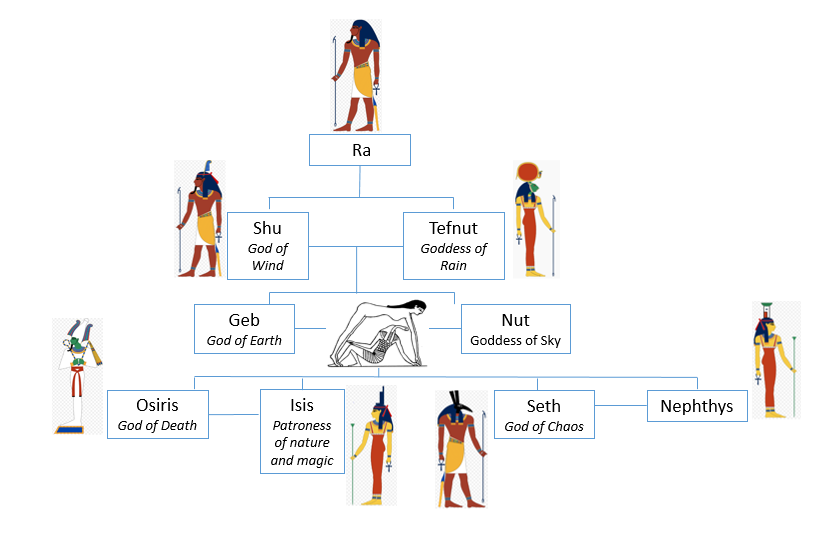
Isis and Osiris: Love Stronger Than Death
Osiris was the “good” king. The bringer of civilization. He was the symbol for the integration of our consciousness (through death and resurrection). He was beloved by all—all except his brother, Set. Set—god of chaos, of the red desert, of storms and violence—could not bear his brother's radiance. Set was the embodied symbol of unconsciousness. The representation of the primal urges that go untamed within us all.
Nephthys, wife of Set, desired a child and, seeing Osiris's admirable rule, disguised herself as her sister Isis to seduce Osiris, resulting in the birth of Anubis. When Set discovered the affair, he was consumed by jealousy and rage, which became a major motivation for his infamous murder and dismemberment of Osiris.
So Set devised a trap: a beautiful coffin, exactly fitted to Osiris's dimensions. Osiris lay down. Set slammed the lid. Sealed it with molten lead. Threw it into the Nile.
And when that wasn't enough, Set tore Osiris's body into fourteen pieces and scattered them across Egypt.
But Isis would not let him go.
Alongside a guilt ridden Nephthys, Thoth, and Anubis, they searched. Through marshes and deserts, transforming into a kite to soar over the landscape. Piece by piece, she gathered her beloved. All but one. The phallus was lost to the river, swallowed by a fish.
And here is where the mystery deepens.
Isis fashioned a new phallus—of gold, of magic, of sheer will. She breathed life into Osiris—not enough to return him to the living world, but enough. Enough to take him inside her. And from that impossible union—death and life intertwined—she conceived Horus.
This is the Sacred Marriage at its most profound: Love that descends into the underworld. The feminine that resurrects the masculine. Sex that defeats death itself.
Set and Nephthys: The Shadow Marriage
Every light casts a shadow. And every sacred marriage has its dark twin.
Set and Nephthys represent the shadow marriage—necessary darkness, incomplete union, the part of us that longs for what it cannot have.
Nephthys longed for Osiris—the light her husband could never embody. Some versions say she seduced him. Some say Anubis, god of death, was born from that shadow encounter.
And yet—when Isis searched for Osiris's body, who helped her? Nephthys. The shadow bride mourning alongside her sister.
The teaching: We are not whole until we honor the shadow's longing too. Light and dark. Isis and Nephthys. Both brides are needed.
Hathor: The Caress and the Claw
Before Isis rose to supremacy, there was Hathor. The Golden One. Goddess of love, beauty, music, dance—and intoxication. She was the divine feminine in her full erotic power.
But Hathor had another face. When the world fell into corruption, Ra grew weary of their constant plotting so from his eye, he sent forth his daughter. Ra transformed Hathor into the fierce lioness goddess Sekhmet to punish humanity.
Sekhmet did TOO good of a job, becoming so bloodthirsty she nearly wiped everyone out until Ra tricked her into drinking beer dyed red with ochre, causing her to fall into a deep sleep and awaken as the benevolent Hathor again, explaining the annual flooding of the Nile. (also explaining the concept of our nervous system states moving from dysregulated to grounded…but that will be saved for another story).
Hathor's teaching: The same force that creates can destroy. Pleasure and rage are one energy. The feminine contains both the caress and the claw.
She does not apologize for either. They both have their necessary roles to play. Our task is to be conscious and intentional with them.
The Beautiful Reunion
Once a year, the goddess went to meet her husband. Not in secret. In a golden barge, on the Nile, with all of Egypt watching.
For fourteen days, Hathor's statue sailed from Dendera to Edfu to unite with Horus. Musicians played. Wine flowed. When she arrived, the statues were brought together in the sanctuary. The doors were sealed.
The Sacred Marriage was the heartbeat of the year. The Nile was the wedding aisle.
Egypt's Map of Your Integrated Consciousness
These myths are not just stories. They are maps.
Osiris is the part of you that was whole—before trauma scattered you.
Isis is the part that searches, that loves you enough to gather you back together.
Set is the shadow you must face—not destroy. The chaos that initiates transformation.
Nephthys is the grief, the longing, the shadow bride who helps heal.
Hathor is what waits on the other side—joy reclaimed, the body remembered as sacred.
You are Osiris, scattered. You are Isis, searching. You are Horus, rising. And you are Hathor—the one who remembers that you were always made of stars.
☥ ☾ ☥
Sources & Further Reading
Plutarch. Isis and Osiris. (c. 100 CE)
Roberts, Alison. Hathor Rising: The Power of the Goddess in Ancient Egypt. Inner Traditions, 1995.
Te Velde, Herman. Seth, God of Confusion. Brill, 1977.
Pinch, Geraldine. Egyptian Mythology. Oxford University Press, 2004.
